
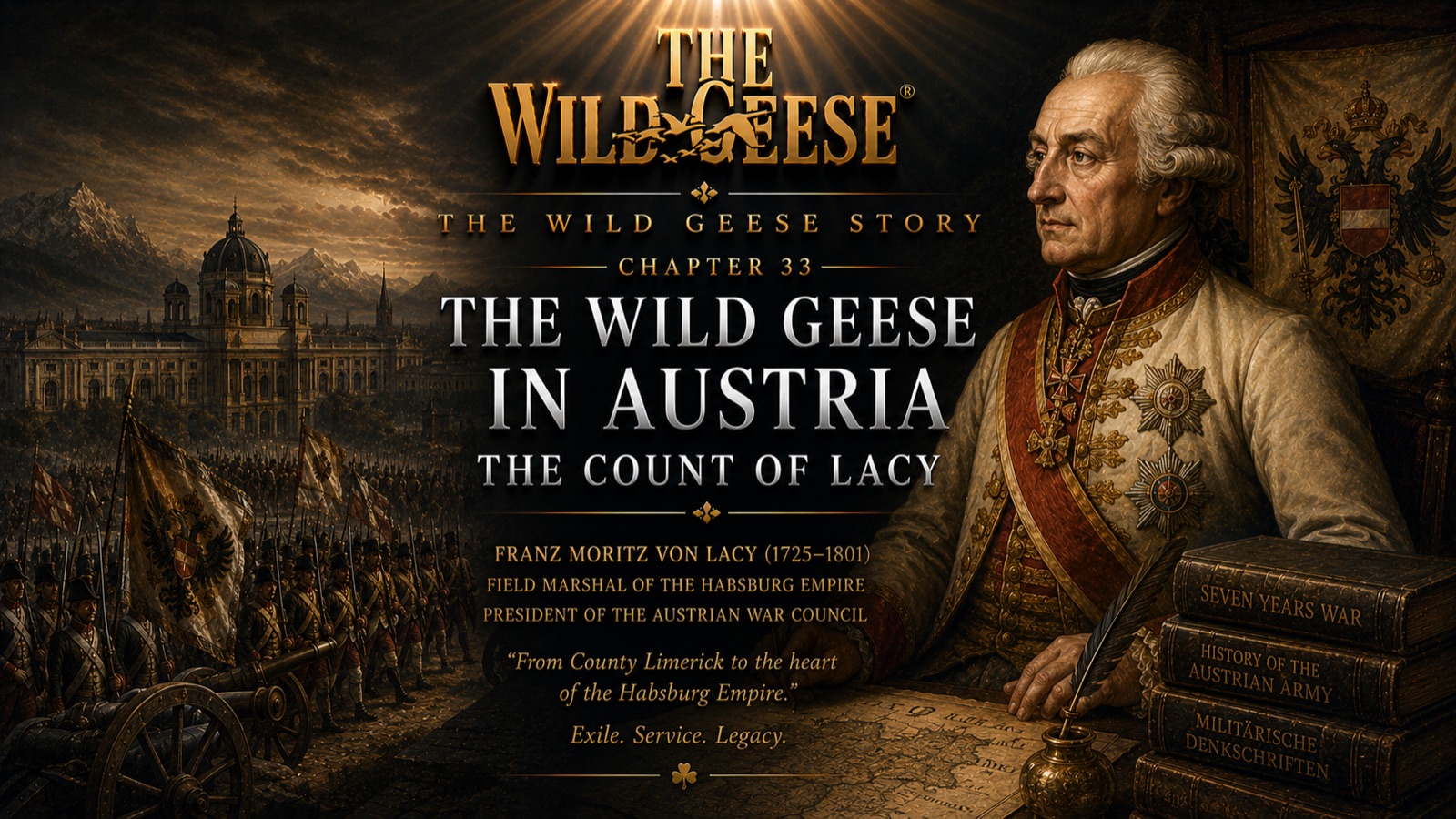
Franz Moritz von Lacy was born in St. Petersburg in 1725, the son of Peter Lacy, an Irish officer from County Limerick who had served first in the Irish Brigade in France, then in the Russian army under Peter the Great, rising to the rank of Field Marshal. Franz grew up in Russia and then moved to Austria, where he became one of the most important military commanders in the history of the Habsburg Empire.
He served under Empress Maria Theresa during the Seven Years War, reorganised the Austrian army after the catastrophic losses of the early campaigns, and rose to become Field Marshal and President of the Austrian War Council. He was the most powerful military official in the Austrian Empire for a generation. His father had been a refugee from County Limerick. He ran the military establishment of one of the great European powers.
The story of the Wild Geese in Austria is less well known than the story in France or Spain, partly because Austria was not the primary destination for the post-1691 exiles, and partly because the Austro-Irish families assimilated more completely into Central European aristocratic culture. But the names are there in the records: Browne, Lacey, Nugent, Butler, Dillon — Irish surnames wearing German and Austrian titles, commanding armies in languages their grandfathers would not have recognised.
The Habsburg officer corps of the eighteenth century contained more Irish blood than most histories acknowledge. The empire was built, in part, by men whose families had been expelled from an island on its far northwestern edge.
