
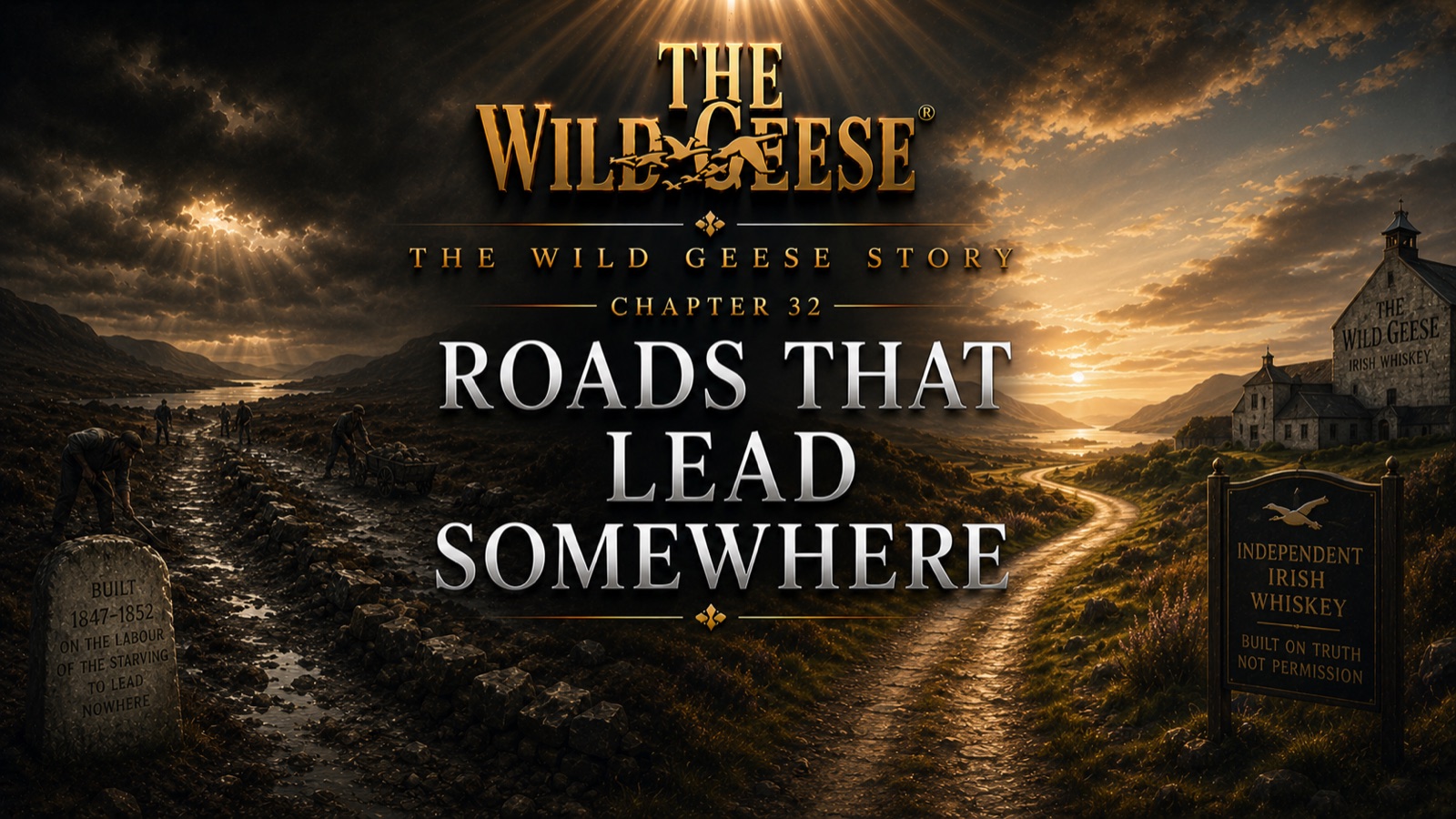
The Famine roads were built by people whose labour enriched no one and served no purpose. Men who were already dying were set to work on roads that started in bog and ended at the edge of a lake, under a policy designed not to feed them but to maintain the principle that nothing should be given without work being extracted in return.
It is the oldest form of commercial pressure: you may have access to what you need, but only on our terms.
Andre and Mairade heard a version of that offer in the years after The Wild Geese was launched. Not in those words. The language of trade law and market practice is more sophisticated. But the structure was the same: access to the category, to the supply, to the shelf — conditional on agreeing not to compete with the dominant player. A French conglomerate selling an Irish whiskey named after a Scotsman, deciding what version of the Irish story was permitted to exist.
They understood what they were being asked to build. A road to nowhere. A brand that traded under someone else’s terms, in spaces defined by someone else’s interests, telling the story of the Irish diaspora at a volume that would never threaten the company that had decided it owned the Irish story.
They declined.
What followed was a legal battle fought across multiple continents over more than two decades. The cost was real. The alternative — accepting a version of the Irish story stripped of everything that made it true — was not an alternative.
The Famine roads are still there in the landscape of the west of Ireland. They serve no purpose. They go nowhere.
The Wild Geese goes somewhere.
