
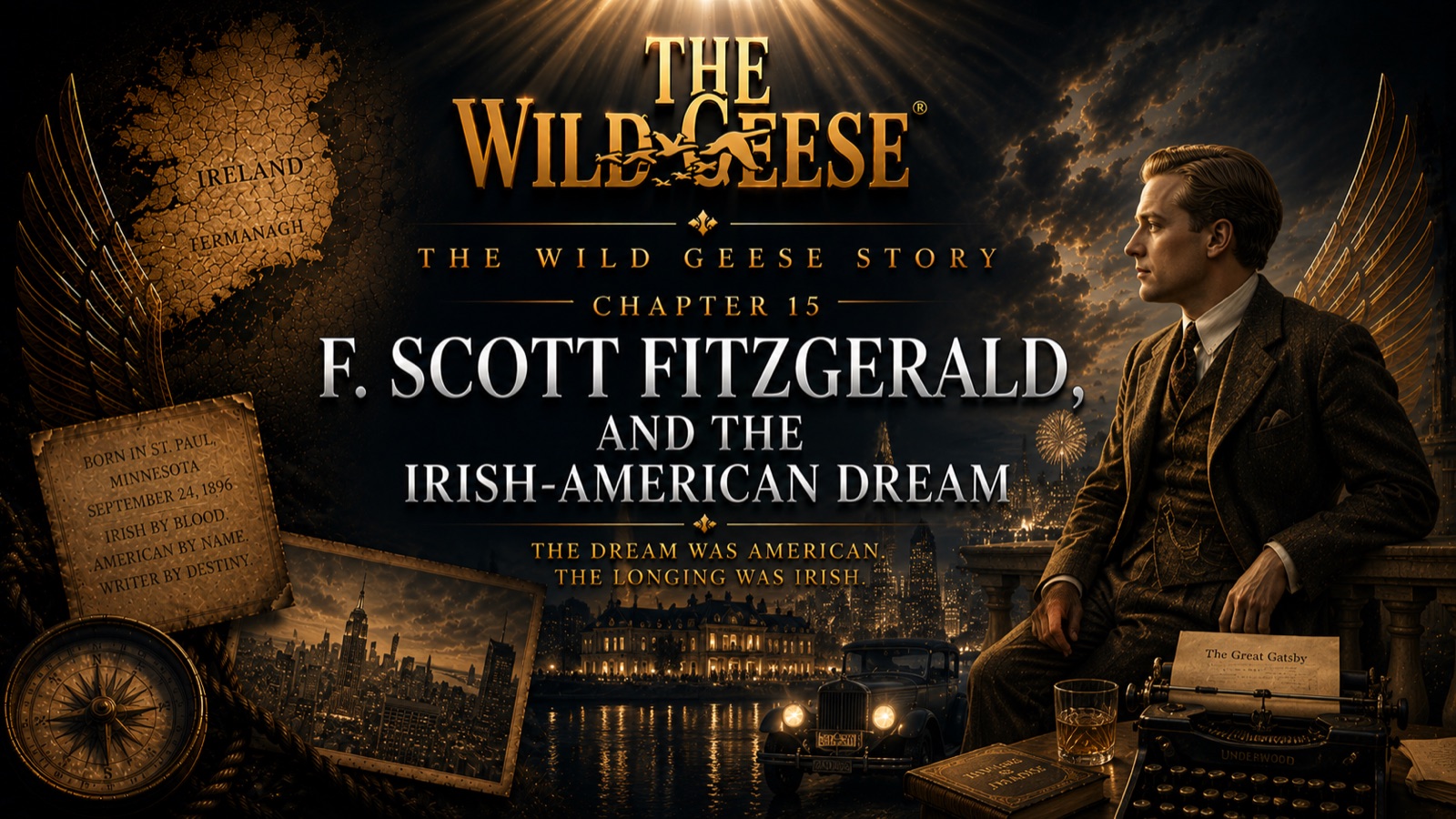
Francis Scott Key Fitzgerald was born in St. Paul, Minnesota, in September 1896, the son of an Irish-American father from Maryland and a mother whose family had come from County Fermanagh. He was named after his ancestor who wrote the words to the Star-Spangled Banner. He spent his life trying to reconcile what America had promised the Irish with what it had actually delivered.
The Great Gatsby, published in 1925, is a novel about aspiration and illusion. It is also, if you read it with the right information, a novel about what happens to the Irish in America — the ones who arrive with nothing, who hustle their way into money, who find that money is not the same as belonging. Jay Gatsby is not Irish by name but he is Irish by circumstance: a man who has remade himself completely and discovered that the world he wanted to join will not let him in regardless of what he brings to the door.
Fitzgerald knew this from his own life. His father’s family had lost whatever social standing they once had. He spent his career in pursuit of an American elite that admired his talent and would not quite accept him, a condition he understood intimately and wrote about with a precision that felt like autobiography even when it wasn’t.
He died in Hollywood in 1940, forty-four years old, in debt, his work undervalued at the time of his death.
Within a decade he would be regarded as one of the finest American novelists who ever lived. The Irish understanding of deferred recognition runs deep.
