
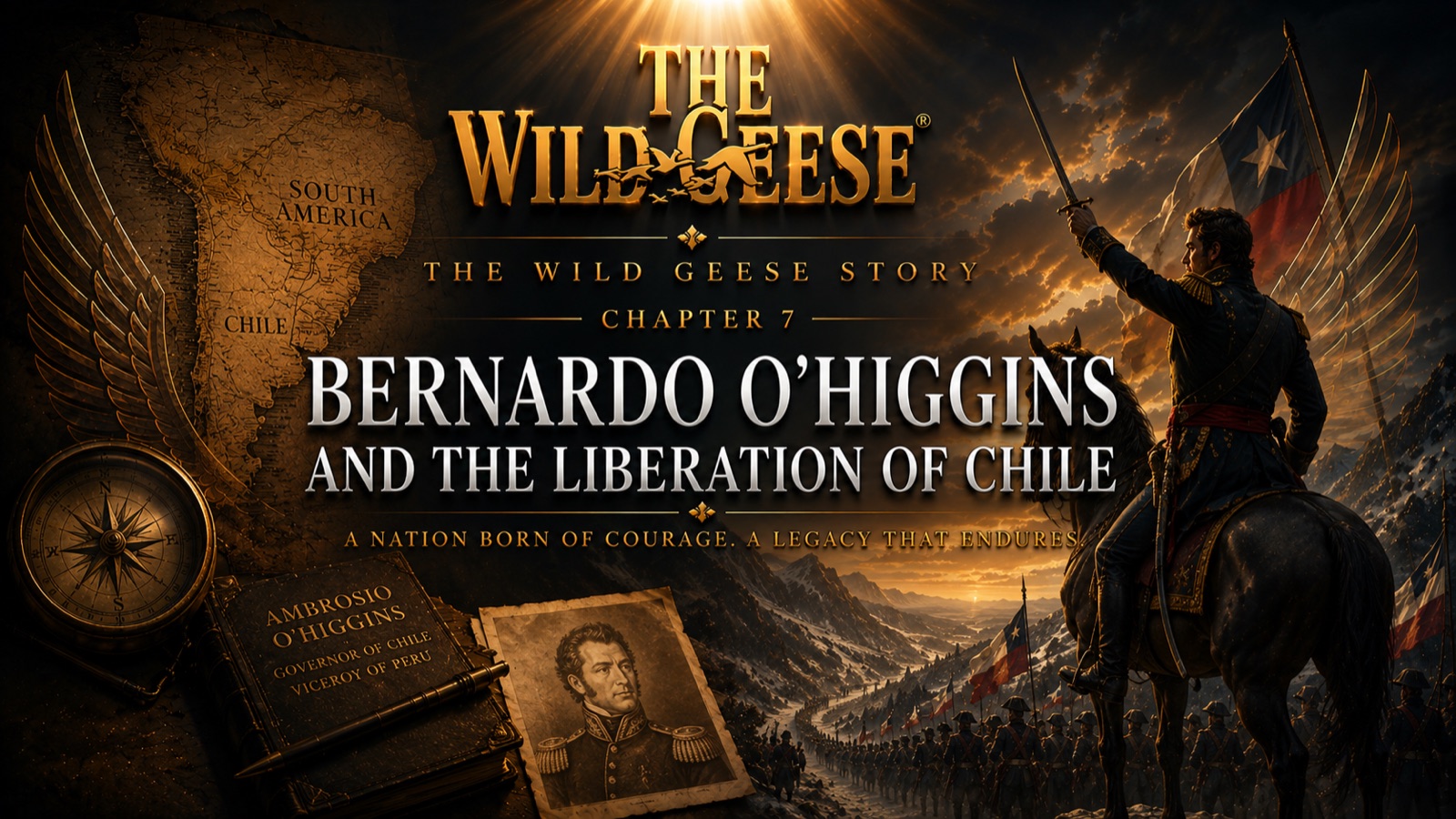
The father of Chilean independence was the son of a man from County Meath.
Ambrosio O’Higgins was born around 1720, probably near Ballinary, in a poor part of the Slieve Bloom uplands. He emigrated, made his way to Spain, worked as a merchant, and eventually landed in South America, where his talent for administration and civil engineering was noticed by the Spanish colonial authorities. He rose to become Governor of Chile and later Viceroy of Peru — the highest administrative office in Spanish South America. He was one of the most powerful officials in the Spanish empire, and he had started as a penniless Irishman who could not afford to stay where he was born.
His son Bernardo, born of a relationship with a Chilean woman, never met his father in any meaningful way. He was sent to Europe to be educated, returned to Chile, and threw himself into the cause of independence. In 1817, alongside the Argentine general Jose de San Martin, he led the Army of the Andes across the Cordillera in winter conditions that should have destroyed them. The Spanish royalist forces, caught by surprise, were defeated at the Battle of Chacabuco.
Bernardo O’Higgins became the first Supreme Director of Chile. The streets, the regions, the institutions of a nation bear his name. In the coastal city of Concepcion, there is a square named O’Higgins. In the bar around the corner, if you order the right whiskey, nobody will think it’s strange.
