
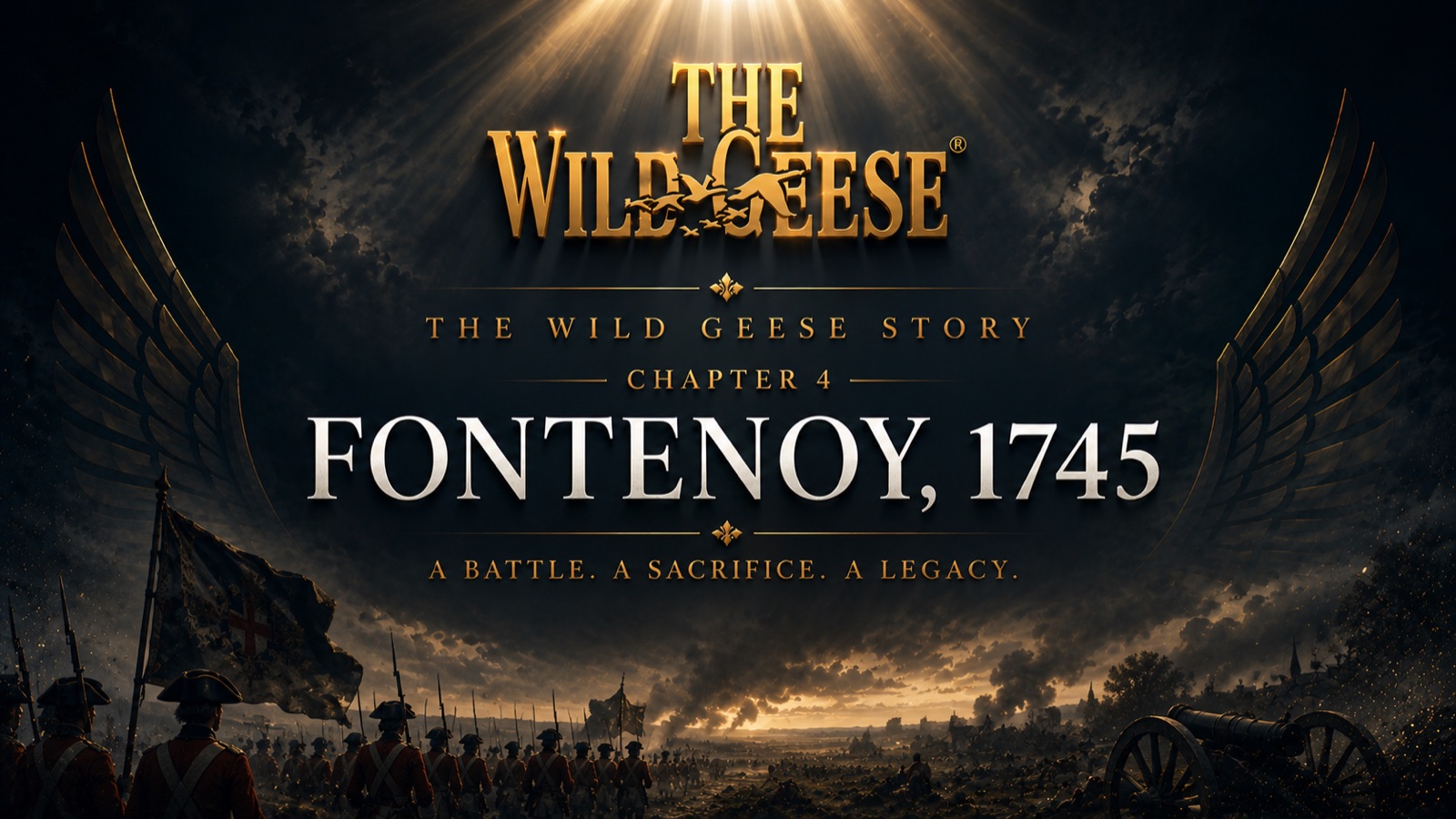
The Battle of Fontenoy is not well remembered in the English-speaking world. In Ireland, it is not forgotten.
On May 11, 1745, a French army under Marshal Saxe was engaged by a combined force of British, Dutch, and Austrian troops in the Austrian Netherlands. By early afternoon, the British infantry had broken through the French lines. They were disciplined, coordinated, and advancing directly toward the French command. Victory appeared certain.
Marshal Saxe sent for the Irish Brigade.
The Brigade had existed in French service for more than fifty years at that point, a legacy of the Wild Geese who had crossed from Limerick in 1691 and the sons they had raised in French exile. They were six regiments of infantry. They had been waiting on the left flank. They had not yet fired a shot.
What followed was described by eyewitnesses on both sides as one of the most ferocious infantry charges of the century. The Irish regiments advanced in formation under sustained fire, closed with the British lines, and broke them. The British withdrew in good order, but they withdrew. Fontenoy was a French victory. The Irish Brigade had made it so.
The accounts say that as they charged, the Irish soldiers shouted a single phrase in Irish. Scholars have argued about the exact words for two hundred years. What is agreed is that they did not call for France. They called for Ireland.
For a few minutes on a field in Belgium, they were not exiles. They were something older and harder to name.
