
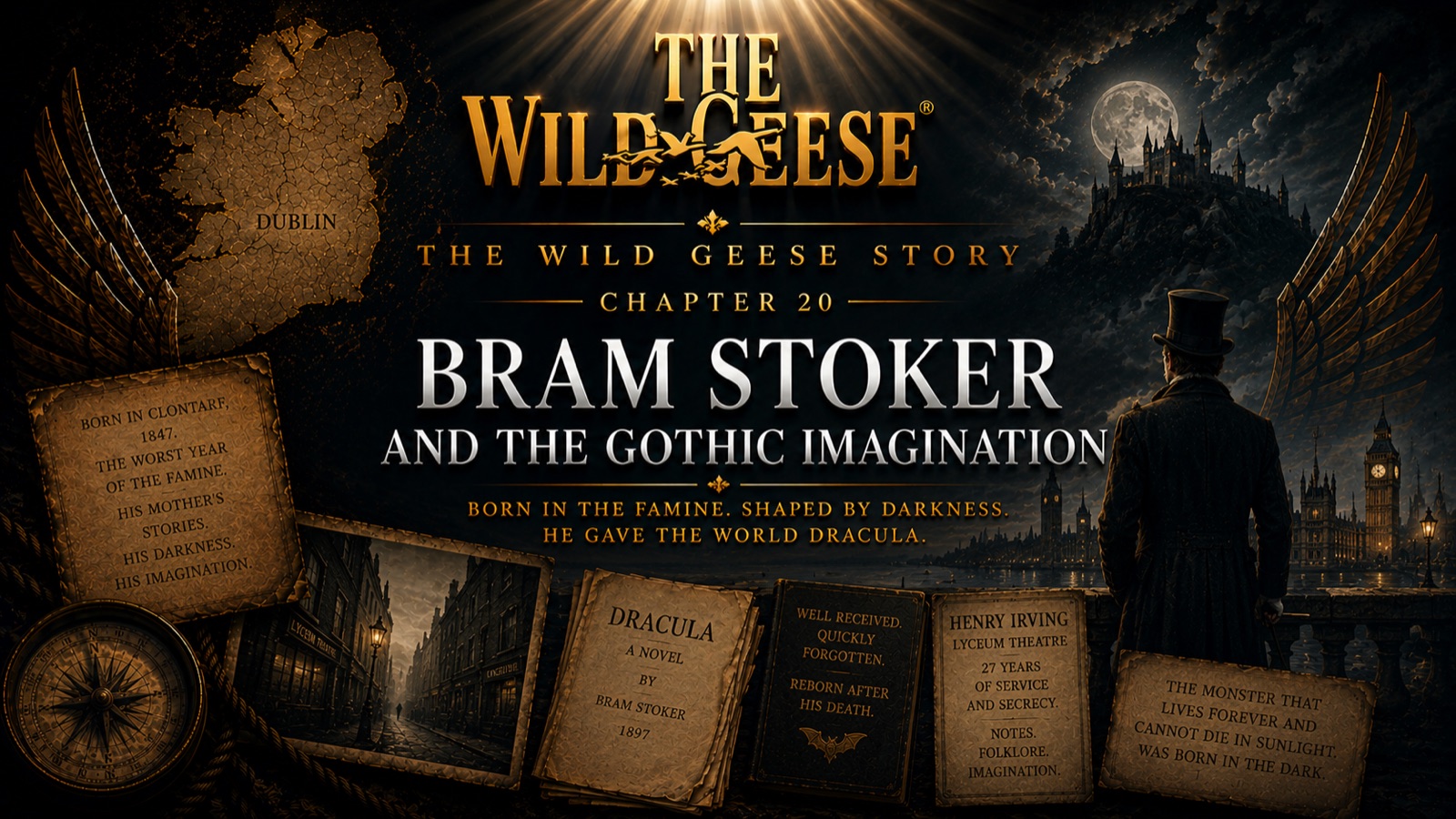
Bram Stoker was born in Clontarf, Dublin, in November 1847, into the worst year of the Great Famine. He was the third of seven children. For the first seven years of his life he was bedridden with an illness that was never properly diagnosed, cared for by a mother who read him Irish folktales and fairy stories and ghost stories from the oral tradition of Sligo, where she had grown up during the cholera epidemic of 1832.
Charlotte Stoker had survived cholera. She had seen things in the west of Ireland in 1832 — mass graves, institutional negligence, the treatment of the rural poor as a problem to be managed rather than people to be helped — that left a permanent mark on her imagination. She passed her darkness to her son along with the stories.
Stoker grew up to be a civil servant and a theatre manager, spending twenty-seven years as the personal assistant to the actor Henry Irving at the Lyceum Theatre in London. In his spare time, over several years, he assembled a novel from his notebooks, his reading, his conversations with people who knew the folklore of Eastern Europe.
Dracula was published in 1897. It was well received and quickly forgotten. It was not until after Stoker’s death in 1912 that it began its second life, the one that turned it into the foundation of an entire tradition of horror fiction, film, and popular culture.
The monster that lives forever and cannot die in sunlight was imagined by a man who had spent his childhood in the dark, listening to his mother’s stories of a place where death came for entire villages and nobody came to help.
