
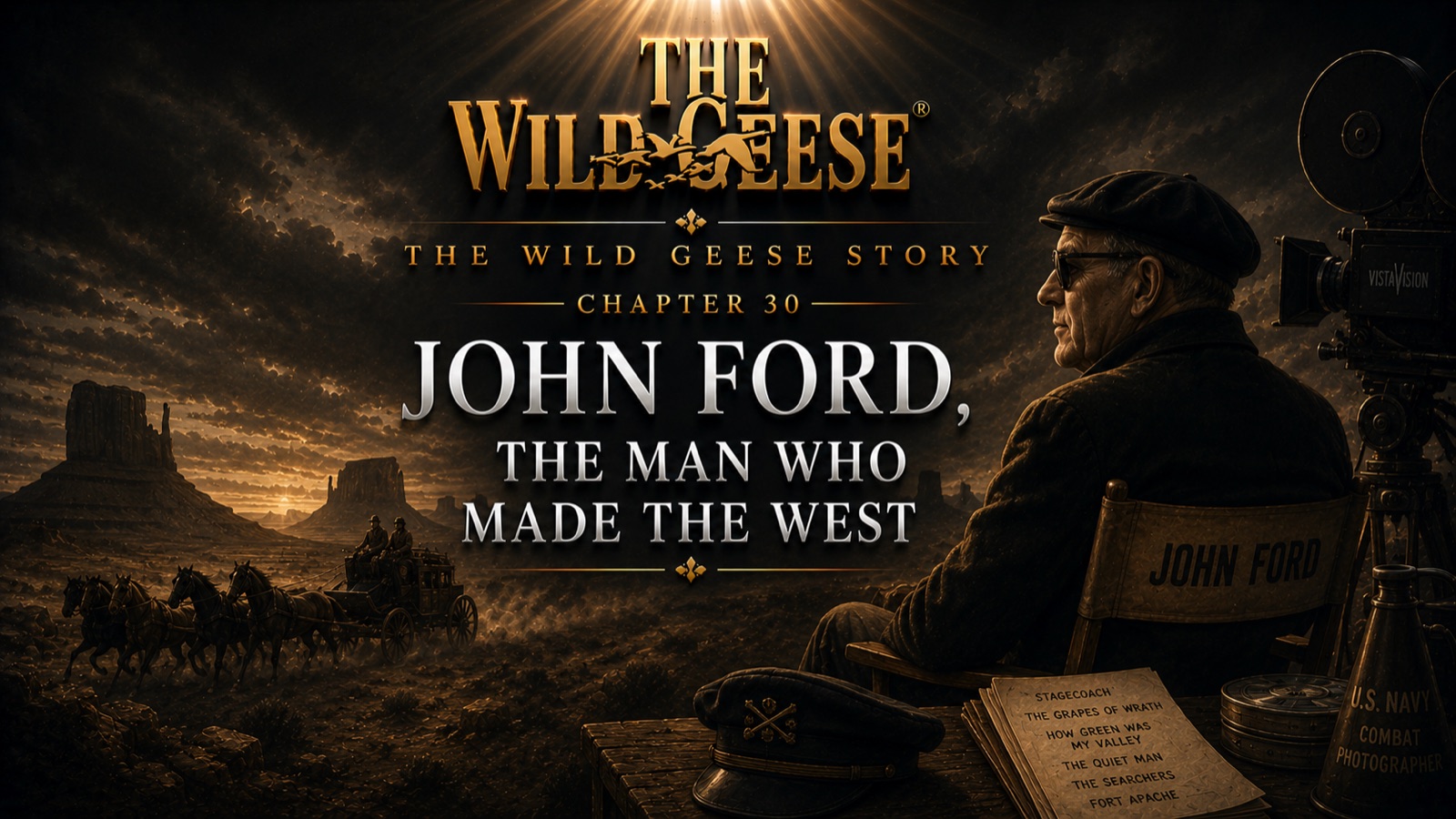
He was born Sean Aloysius O’Fearna in Cape Elizabeth, Maine, in 1894, the thirteenth child of Irish immigrant parents from County Galway. He went to Hollywood at seventeen, changed his name to John Ford, and spent the next sixty years making films about America that told a story simultaneously simpler and more complicated than the country itself could manage.
Ford won four Academy Awards for directing. No one else has won four. He made Stagecoach, The Grapes of Wrath, How Green Was My Valley, The Quiet Man, The Searchers, Fort Apache. He invented much of the visual language of the Western genre — the Monument Valley landscapes, the cavalry charges, the saloon confrontations, the sense that the American west was a place where character was tested and occasionally, rarely, found adequate.
He made a particular kind of American hero: stoic, principled, damaged, capable of both great loyalty and great cruelty, ultimately alone. Scholars have noted that this is not an Anglo-Saxon archetype. It has specific Irish characteristics — the exile’s relationship to belonging, the warrior’s relationship to loss, the community’s suspicion of the man who does what is necessary and is never quite forgiven for it.
He served in the United States Navy during the Second World War, filming the Battle of Midway under fire from the Japanese. He was wounded. He kept filming.
Late in life, asked why he had never made a film explicitly about Ireland and the Irish, he said that everything he had ever made was about Ireland and the Irish, and that anyone who had been paying attention would know that.
