
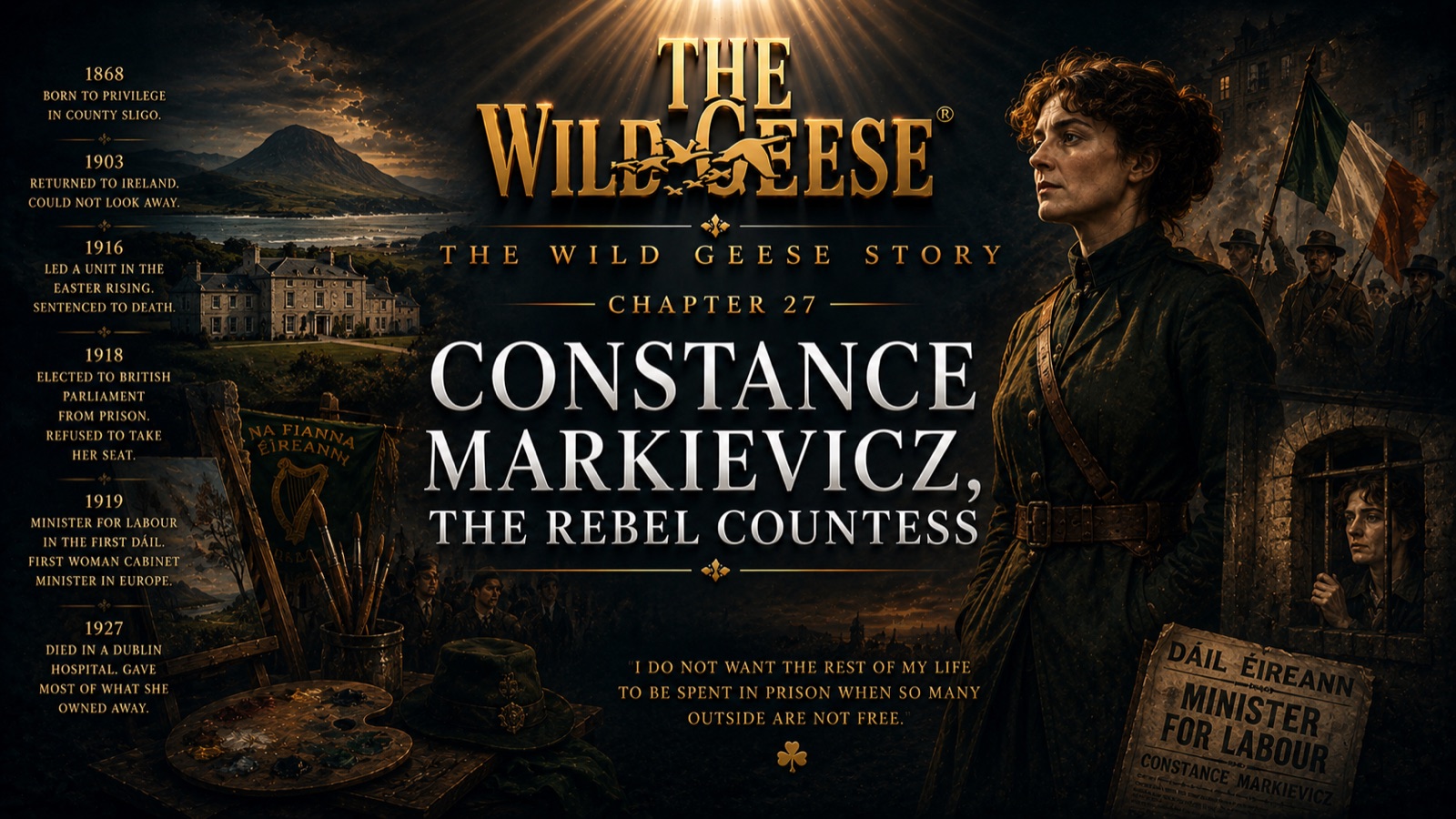
She was born Constance Georgina Gore-Booth in 1868, into one of the Protestant Anglo-Irish landowning families of County Sligo, in a house with a mountain behind it and a view of the Atlantic in front. She was presented at the court of Queen Victoria. She studied painting in Paris. She married a Polish count and went to live in his country for several years. She returned to Ireland in 1903 a countess, a painter, and — gradually, then suddenly — a revolutionary.
The transformation is not as unlikely as it seems if you understand the Ireland she came back to. The Sligo she had grown up in was a place shaped by the Famine, by eviction, by the grinding poverty of the Catholic poor who worked on her family’s land. She had seen it as a child. As an adult, with the leisure to look at it properly, she could not look away.
She joined the emerging revolutionary movement. She founded Na Fianna Eireann, a nationalist youth organisation. She fought in the Easter Rising of 1916 in St. Stephen’s Green, commanding a unit of the Irish Citizen Army, the only woman to hold a command during the Rising. She was sentenced to death. The sentence was commuted on grounds of her sex — an act of gallantry that she found, quite reasonably, offensive.
In 1918, she was elected to the British Parliament from prison. She did not take her seat. In 1919, she became Minister for Labour in the first Dail, the first female cabinet minister in the history of European democracy.
She died in 1927 in a public ward in a Dublin hospital, having given most of what she owned away. A countess who died among the people she had chosen.
