
The Irish community in Spain has roots that most Spaniards and most Irish people are only beginning to rediscover.
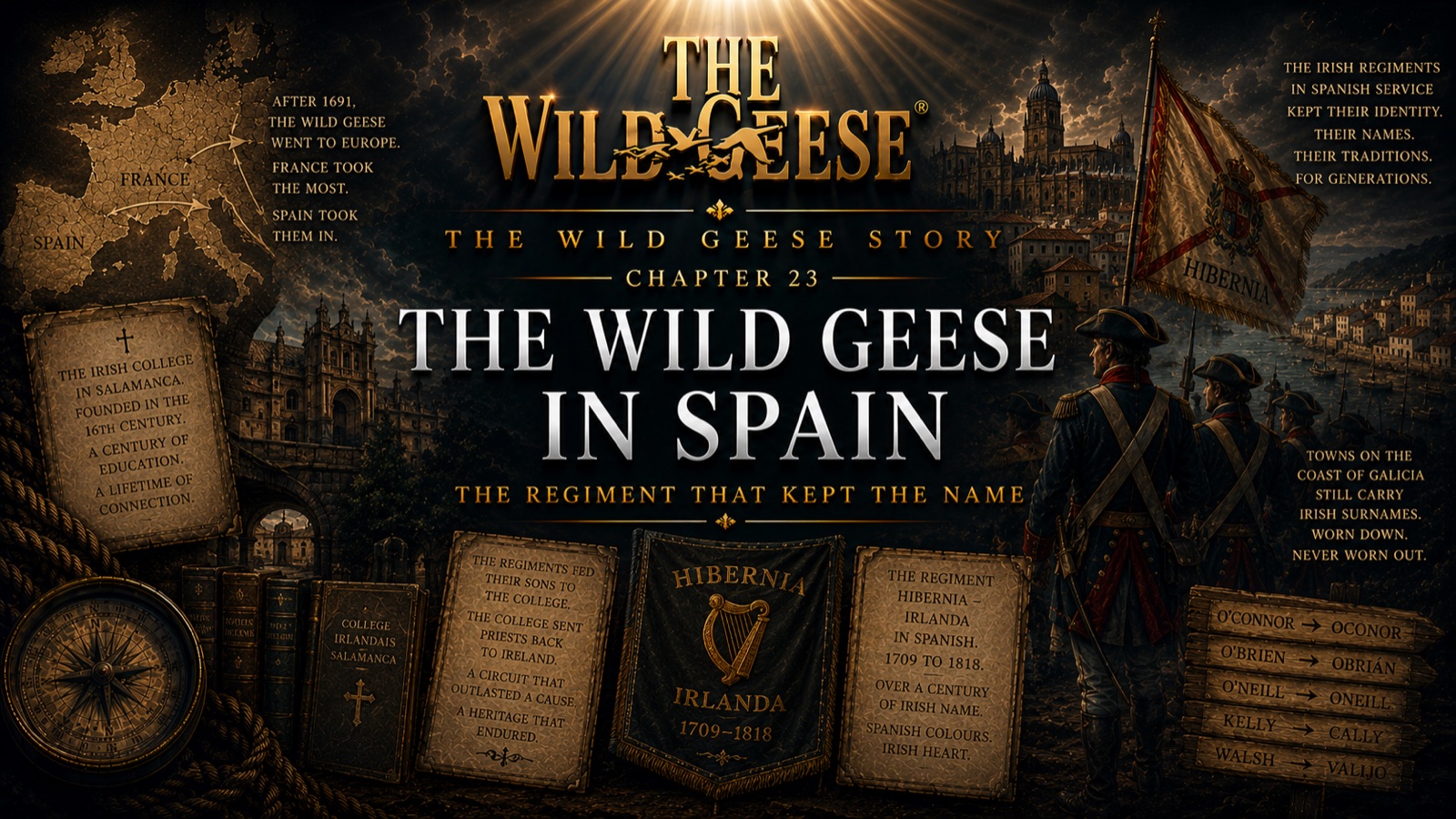
When the Wild Geese arrived in Europe after 1691, they went primarily to France — France had the largest Irish Catholic community, the most active recruiters, and the clearest military need for infantry. But Spain also took them in, and the Irish Regiments in Spanish service became something remarkable: units that maintained their Irish identity across generations, that kept Irish surnames in their officer lists and Irish traditions in their garrison life, long after the men who had crossed from Limerick were gone.
The Irish College in Salamanca, founded in the late sixteenth century, had been educating Irish Catholic clergy in Spain for a century before the Wild Geese arrived. It became the cultural anchor of the Irish-Spanish community. The regiments fed their sons to the college. The college sent priests back to Ireland. A circuit of cultural transmission was established that outlasted the Jacobite cause it had been built to serve.
The regiment Hibernia — Irlanda in Spanish — existed in the Spanish army from 1709 until 1818. For over a century, a regiment wearing Spanish colours maintained an Irish identity and an Irish name in the armies of a country that had taken them in when their own had been taken from them.
There are towns on the coast of Galicia where you can still find Irish surnames worn down to Spanish phonetics, names that arrived in 1691 and have been there ever since.
