
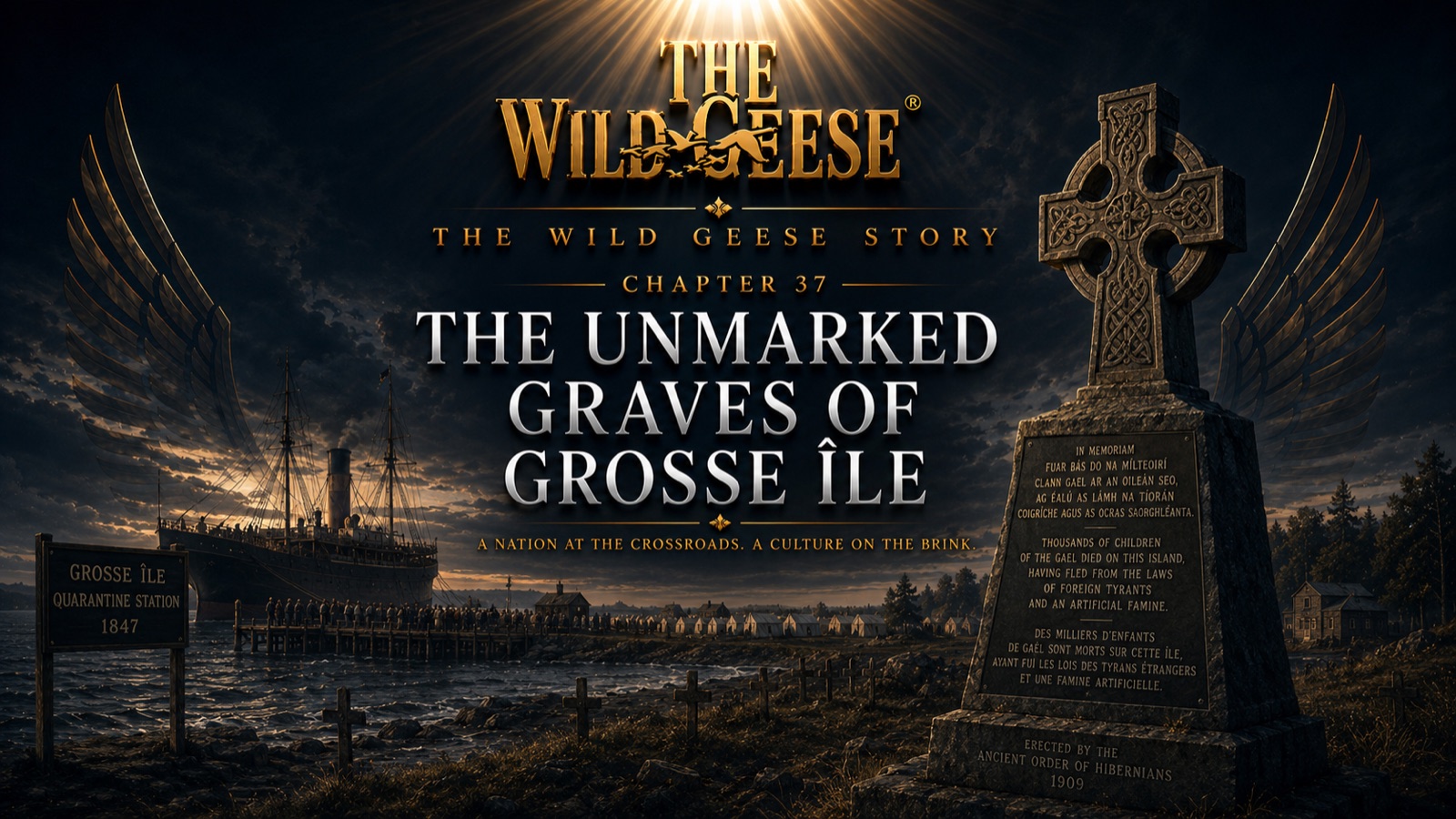
Grosse Ile is a small island in the St. Lawrence River, about thirty miles east of Quebec City. In 1847 it was the quarantine station for ships arriving from Ireland, and it became a place where the Famine arrived in Canada.
The ships came through the spring and summer of 1847 in numbers that overwhelmed every preparation the authorities had made. The quarantine station had been built for a few thousand people. By mid-summer it was holding forty thousand. The sick were separated from the well — or were supposed to be — but the conditions were too chaotic for the separation to be effective, and the disease spread from ship to ship, from pier to tent to shed.
More than five thousand people died at Grosse Ile in 1847. They were buried in mass graves on the island, without individual markers, without their names being properly recorded in many cases. Families arrived in Canada with fewer members than had left Ireland. Parents lost children on the island. Children were orphaned there and farmed out to local Catholic families who raised them as their own, sometimes with Irish names, sometimes renamed entirely.
The island was a quarantine station for another fifty years after the Famine. In 1984 it was designated a National Historic Site. The mass graves are still there.
There is a monument on the island erected by the Ancient Order of Hibernians in 1909, a Celtic cross with an inscription in Irish, English, and French. The Irish portion reads, in translation: Children of the Gael died in their thousands on this island, having fled from the laws of the foreign tyrants and an artificial famine.
Artificial. It is a word that has never stopped being debated.
